



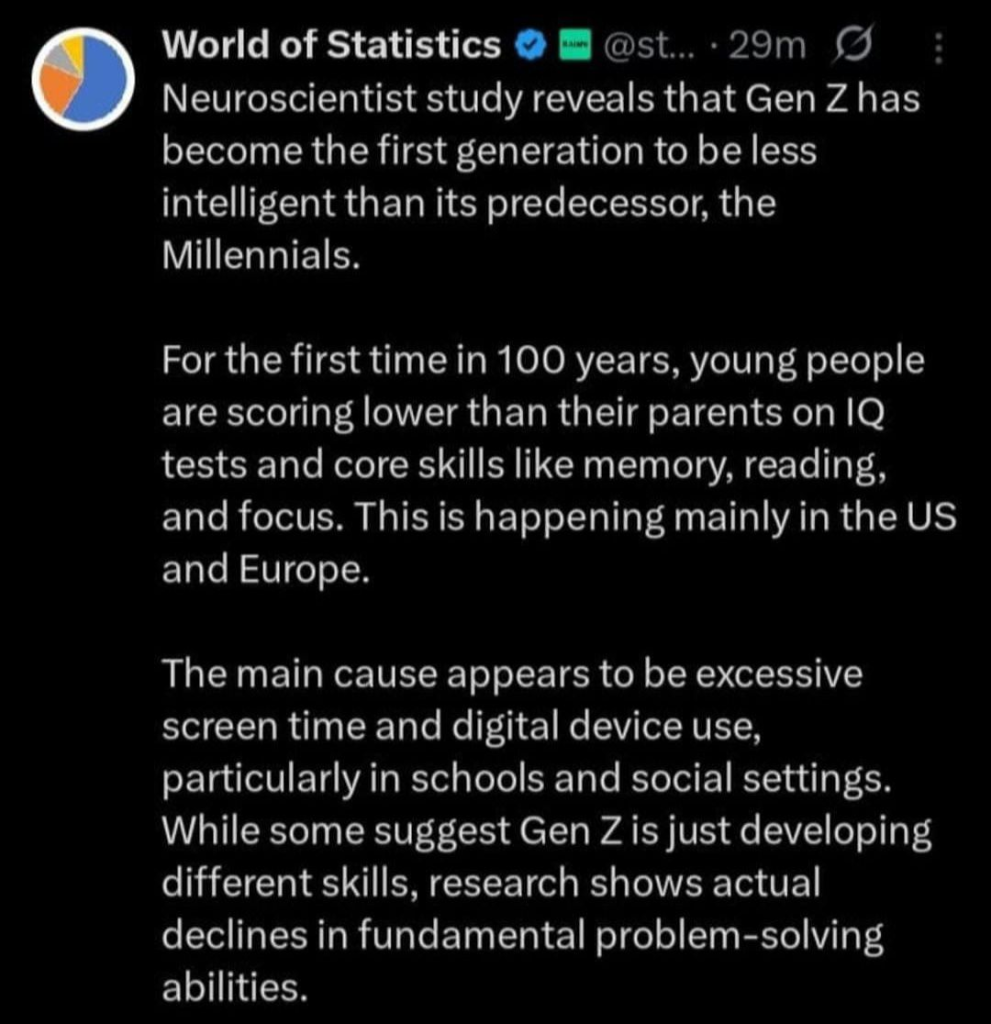
Recent international research analyzing standardized cognitive assessments has sparked widespread discussion after suggesting that Generation Z may be scoring lower on traditional IQ tests compared to Millennials at similar ages. While the findings have generated headlines and concern in some circles, experts emphasize that the issue is far more complex than it may initially appear.

Several large-scale studies conducted across North America and parts of Europe indicate a modest decline in average scores on certain standardized intelligence tests among younger cohorts. Researchers examining these trends have pointed to a variety of potential contributing factors, including increased screen exposure, shorter attention spans influenced by digital media consumption, evolving educational systems, and disruptions caused by the COVID-19 pandemic.

One of the most frequently cited explanations involves the digital environment in which Gen Z has grown up. Unlike previous generations, Gen Z has been immersed in smartphones, social media, and fast-paced online content from an early age. Some psychologists argue that constant digital stimulation may influence concentration patterns, deep reading habits, and sustained analytical reasoning — skills that traditional IQ tests tend to measure.
In addition, pandemic-related school closures and remote learning disruptions are believed to have had measurable academic impacts. Interrupted classroom instruction, social isolation, and uneven access to digital learning resources may have affected cognitive development and test performance for some students during critical formative years.

However, many scholars caution strongly against framing these findings as evidence of a generational intellectual decline. IQ tests primarily measure specific forms of reasoning, memory, pattern recognition, and analytical problem-solving. They do not capture qualities such as creativity, emotional intelligence, adaptability, collaboration skills, or digital fluency — areas where Gen Z is often considered highly capable.


